Dimension X
The Show That Proved Science Fiction Belonged on Radio
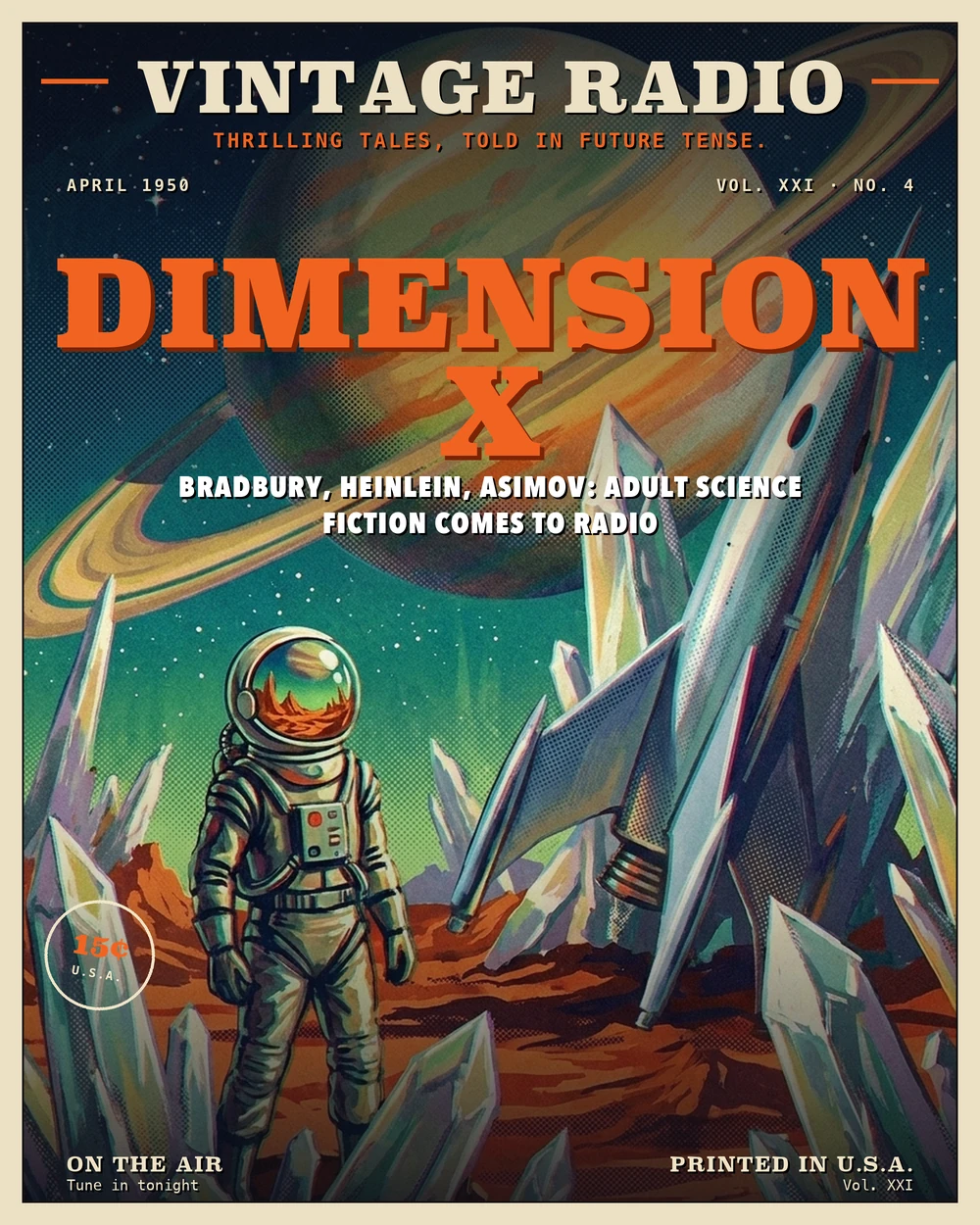
Before Dimension X, science fiction on American radio was almost entirely a children's affair. Flash Gordon, Buck Rogers — serials aimed at Saturday-morning ears, not adults sitting down in the evening for serious drama. In the twenty-five years radio had been a mass medium, the genre had been largely ignored, showing up only occasionally in anthology programs like Escape or Suspense, and even then rarely. NBC's Latitude Zero back in 1941 had been an occasional hybrid attempt; the little-known Two Thousand Plus on Mutual had made a modest earlier try at an adult format. Then NBC put Dimension X on the air on April 8, 1950, and the landscape changed.
The timing helped. The film Destination Moon was in theaters, and 1950 was shaping up as a breakout year for the genre. A small Chicago series called Cloud Nine briefly appeared on CBS that July, carrying work by Jack Finney. But Dimension X was the show that established what radio science fiction could actually sound like when given the resources and the source material to do it right — and that strong standing came almost immediately, because the show went straight to the writers the science fiction community already cared about.
The Source Material
What set Dimension X apart from anything that had come before was the roster of writers it drew from. Stories came from Ray Bradbury, Isaac Asimov, Robert Heinlein, Clifford Simak, Robert Bloch, Jack Williamson, Kurt Vonnegut, Murray Leinster, Fredric Brown, Jack Vance, William Tenn, H. Beam Piper, and others — many of them originating in Astounding Science Fiction Magazine. The second episode, broadcast April 15, 1950, was Williamson's "With Folded Hands," one of his most famous stories. A week later came Vonnegut's "Report on the Barnhouse Effect," starring Santos Ortega and Bob Hastings. Adapters Ernest Kinoy and George Lefferts worked through this material with care, and the results held up against the best drama on network radio at the time.
A few adaptations stand out in the record. Heinlein's "Green Hills of Earth" — the story of a blind spacefarer and folksinger — translated well to an audio medium where sightlessness becomes almost a metaphor for the listener's own relationship to the story. Heinlein's "Universe," which aired August 2, 1951 with Mason Adams and Peter Capell, told of a generation ship in transit so long that the crew's descendants had completely lost touch with the purpose of their journey; the script carries sharp ironies about the dangers of religious zealotry. Bradbury's "There Will Come Soft Rains," depicting the end of the world by atomic war, and "Zero Hour," depicting it by alien invasion, both aired in a single episode — a double dose of apocalypse. Kinoy's adaptation of The Martian Chronicles compressed Bradbury's book into a coherent half-hour, which is no small achievement. The series finale, September 29, 1951, was Asimov's "Nightfall," starring John McGovern and Staats Cotsworth.
Not every episode landed with equal force. The opening installment, "The Outer Limit" — adapted by Kinoy from Graham Doar's short story in the Saturday Evening Post of December 24, 1949 — was an unfortunate choice: the story had already appeared on Suspense, Escape, and other anthology series, and its premise leaned too heavily on a gimmicky ending. But Lefferts and Kinoy also produced original work that stands beside the adaptations. Lefferts wrote "No Contact," a chilling original tale of ships lost to a mysterious "galactic barrier" and one ship that tried to cross it again — a true radio classic. And Kinoy's original story "The Martian Death March," its premise drawn from the forced removal of the Cherokee Indians in 1838, ranks among the strongest pieces in the entire run.
The Way It Sounded
Dimension X was recorded in a massive NBC studio, two stories high with a tour observation booth above the floor. That space mattered. NBC engineer Bill Chambers, in a letter to Dimension X advocate Bill Sabis, described how the size of the room let the production team achieve tremendous echo effects — echo so deep, Chambers noted, that the recording equipment of the era couldn't fully capture it. Two and sometimes three sound effects men worked each episode, and that labor showed in the texture of the finished broadcasts.
Albert Berman's music was composed for and played on the organ, and it ran in a distinctly futuristic direction. The theremin — an exotic electronic instrument — was used liberally, giving the show its eerie, outer-space atmosphere at a time when that sound was still genuinely novel on a drama program. After Norman Rose's opening narration, the organ played a crescendo sting; on later episodes, that sting was layered with tympanic rolls and cymbals.
Rose himself was central to the show's character. His narration combined authoritative resonance with a touch of dark irony, and he opened each episode with the same words: "Adventures in time and space … told in future tense! DIMENSION X…X…x…x…x…x…" — the echo treatment trailing the title off into the distance. It became one of the more distinctive openings in radio drama of the period. Rose, born in Philadelphia in 1917, had honed his craft at the Actors Studio Drama School and on Broadway in Richard III and St. Joan; during World War II, the Office of War Information recruited him as a radio newscaster. His baritone was known among colleagues as "the Voice of God" — the same voice that, decades later, sold Colombian coffee as Juan Valdez and narrated the seventieth Academy Awards.
The Cast and the Writing Room
The cast was drawn entirely from New York radio personnel, and NBC assembled a large rotating company for the run. Among those who appeared across the series: Joseph Julian, Joe DeSantis, Luis Van Rooten, Santos Ortega, Alexander Scourby, Arnold Moss, Joan Alexander, Raymond Edward Johnson, Jan Miner, Berry Kroeger, Donald Buka, Leon Janney, Ralph Bell, Mason Adams, and many others. The depth of the New York radio talent pool in this period meant that even supporting roles were handled by experienced performers.
Ernest Kinoy and George Lefferts deserve particular attention. Kinoy, born in New York in 1925, had a wartime story of his own — captured during the Battle of the Bulge with the 106th Infantry Division, interned at Stalag IX-B, and then sent to the slave labor camp at Berga. He joined NBC as a staff writer in 1948 and stayed until 1960. After leaving radio he went on to win two Emmys, one in 1964 for "Blacklist," an episode of The Defenders, and another in 1977 for co-writing an episode of Roots. He later wrote screenplays for Sidney Poitier (Brother John, Buck and the Preacher) and the 1981 television movie Skokie. Kinoy and Lefferts also co-wrote Rocky Fortune, the 1953–54 NBC vehicle for Frank Sinatra.
Van Woodward and William Welch produced, with directing split among Edward King, Jack Kuney, and Fred Weihe. Robert Warren announced, with Fred Collins filling in occasionally and Frank Martin handling the duty during the Wheaties weeks. Chambers engineered; Agnew Horine and Sam Monroe ran sound.
A Difficult Schedule and an Honest Legacy
General Mills sponsored Dimension X for Wheaties during a two-month stretch beginning July 7, 1950. Outside that window, the show ran as a sustaining program — unsponsored, which meant it was subject to the scheduling disruptions that tended to follow unsponsored network drama. The slot moved from Saturdays to Fridays to Sundays and back to Saturdays, and the show was dropped from the NBC lineup for weeks at a time. During almost all of the first half of 1951, it was absent from the schedule entirely — a gap of nineteen weeks. CBS's Escape faced a similar pattern, and like Escape, Dimension X overcame the bad scheduling to deliver some of the best radio drama of its season.
The show was produced live for its first thirteen weeks, then moved to tape. Fifty broadcasts were produced across the run, of which forty-six were unique; four were rebroadcasts, including a second airing of "The Outer Limit" that September. All fifty survive in uniformly excellent sound — something that can't be said for every drama of the period.
Dimension X directly spawned X Minus One, which debuted April 24, 1955 and ran for 126 broadcasts until January 1958. The first fifteen episodes of X Minus One were Dimension X scripts recast with new performers and updated sound effects; from episode sixteen onward the show went to original material. Kinoy and Lefferts carried over as the core writing team, and X Minus One is widely considered one of the finest science fiction anthologies ever produced for radio. The case it makes — and that Dimension X made first — is that radio and science fiction were ideally suited to each other, because the imagination conjures illusions that no set of television props can match. The evidence of what Dimension X actually produced, episode after episode, on a shoestring, with an irregular schedule and no long-term sponsor, makes a reasonably strong case for the claim.